227 Ways to Smell
- October 7, 2026
- Cultivation & Genetics
- 12 mins read
The new terpene census, and why two plants of the same name smell nothing alike.
By Puff 'n Post | Genetics & Cultivation
Six of them on a Friday afternoon, all six talking at once about what the weekend required. I am not going to tell you where this was. Partly because it does not matter, and mostly because I could not swear to it now if you paid me.
Six voices. Six opinions. All that noise and all that perfume and a row of open jars, and one lad in the middle of it going under for the third time, with the expression of a man who has walked out into weather he owns no coat for.
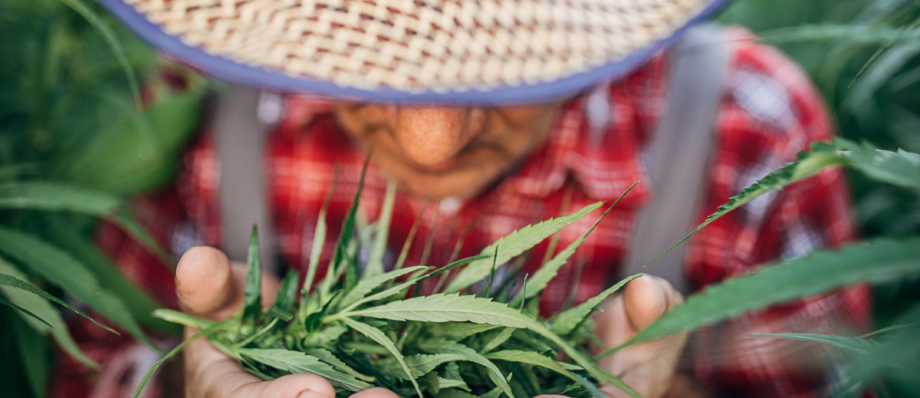
I was in a hurry. I picked up the GG#4, put my nose in it and took my time about it, the way you should, and breathed out slo+wly. Then I held it across to the one standing nearest me, the one with the Jessica Alba face, and said: smell.
We went through five or six jars like that. Nobody looked at a label. The debate carried on regardless, the decision did not arrive, and after a while I asked the only question that has ever worked in a room like that.
Which one do you remember.
She said the GG#4 before I had finished the sentence.
She was right. I had agreed with her before she said it. And between the two of us we had not read a single word on a single jar.
The lie on the label
There is a species of lie that is not quite lying, the kind a man tells himself in a decent mood and has come to fully believe by the time he wakes up, and the entire retail architecture of cannabis has been built on top of it. The lie is the name. Somebody writes Gelato on a jar, in a font chosen by a marketing graduate who has never had his hands in soil, and that name is then asked to perform the labour that chemistry ought to be performing. It promises a sensation. It implies a bloodline. Above all it flatters the man holding the jar into believing that he is a connoisseur and not simply a bloke buying a bag.
The honest version of that transaction is shorter. It smells like a jar. You smoke it. Something happens. Then you go to work.
The honest version is also closer to the science than anything the marketing department has produced.
And look at what I was holding. GG#4 is not what it was christened. It came to market as Gorilla Glue #4, until an adhesive company in Ohio sued the Las Vegas breeders for trading on its name, and the settlement gave them a year to strip the word gorilla and the gorilla itself off everything they sold. No money changed hands. The plant was not consulted. By September 2018 it was GG4, and the only thing about it that had changed was the noise you make when you ask for it.
Which is the whole argument in miniature. A name can be removed by a court in another hemisphere without a single terpene shifting. Whatever the plant is, it is not its name.
The count
A team publishing in Acta Pharmaceutica Sinica B has just done the tedious, unglamorous, absolutely necessary thing that nobody gets rich doing. They counted. Twenty eight samples, six cultivars, taken at weekly intervals across the plant’s development and at different stages of maturity, every one of them run through the machines until the machines had nothing left to say.
The count came back at 227 volatile terpenes. Eighty eight monoterpenes and one hundred and thirty nine sesquiterpenes.
Two hundred and twenty seven. Your label lists three.
And the smell is not spread evenly through the plant, which is the first thing that ought to give a buyer pause. The flowers and the bracts are the whole factory. The roots and the mature seeds are very nearly mute. In one of the six cultivars they found exactly one volatile terpene in the roots and three in the mature seeds, which is to say the plant spends its entire cologne budget on the one part of itself that anybody was ever going to pay for. There is a whole essay in that, about advertising and about the parts of a life that get the funding, and I will spare you it.
The machinery underneath
Here is where it stops being a smell and starts being an argument. The researchers built a genome for one cultivar in which both inherited copies were resolved separately, rather than mashed into a single averaged version, and then went looking for the genes that make terpenes. They found fifty six candidates. Once the broken and truncated ones were thrown out, forty one survived as full length, functional prospects. Eighteen of those belong to the family that mostly makes the light, volatile monoterpenes, and fourteen to the family that handles the heavier ones.
They sit in clusters, the way genes do when evolution has been photocopying something it liked. One stretch of the genome held twelve of them packed inside about 480 000 letters of DNA. And the two inherited copies of the genome did not agree with each other about how many there were or where they sat, which means that two plants can be siblings and still be issued different equipment at birth.
Then the detail that should be printed on the inside of every breeder’s eyelids. One gene, well expressed in the flowers, closely resembling a known working enzyme, everything about it correct on paper, turned out in one version to be missing a single critical piece of molecular architecture. It did nothing. It was a factory with the lights on and nobody inside. Having the gene, and even switching the gene on, does not mean the compound gets made.
There is the whole of the human condition in that sentence and I am not going to pretend otherwise.
The enzymes are not loyal
The old assumption was one gene, one enzyme, one smell, a tidy production line. The researchers took six previously uncharacterised enzymes, put them into engineered bacteria, fed them the raw material and watched what came out.
What came out was not tidy. One enzyme produced mainly limonene and myrcene when it was fed one precursor, and then produced something else entirely, a heavier compound, when it was fed a different one. Another made mostly ocimene from the first feedstock and two quite different compounds from the second. These enzymes are not specialists. They are opportunists. They make what the situation allows, which is how a plant generates an enormous vocabulary of smells without carrying an enormous vocabulary of genes.
And when the researchers checked whether gene activity actually predicted how much of each terpene ended up in the plant, it did not. Not reliably. Availability of raw material, enzymes with several possible outputs, overlapping jobs between different enzymes, chemical tinkering after the fact, all of it intervenes between the instruction and the result.
One clean example survived the mess, and it is a good one. A cultivar called Painkiller barely makes trans beta ocimene, while in three of the others it is one of the dominant compounds. The reason is a single terpene synthase gene running roughly twenty times quieter in Painkiller than in the other five. Sometimes the line from gene to nose is that short. Usually it is not.
What this does to the name on the jar
Four years ago a study in PLOS ONE took commercial cannabis from six American states and asked a rude question: do the labels correspond to the chemistry. The answer was that distinct chemical types genuinely exist, they are real and they are reliably present, but the commercial names attached to the material do not consistently track them. Some names lean towards a chemical type. None of them guarantee one.
The authors put it in the flat, devastating register that scientists use when they have decided to stop being polite. The classification of commercial cannabis, the design of research, and the regulation of consumer marketing are, in their words, often divorced from the chemical reality of the material they claim to represent.
Put the two papers side by side and the position is unavoidable. The plant contains 227 volatile compounds. Which ones it makes depends on the cultivar, on which part of the plant you take, on how far into flowering you take it, on which copy of which gene it happened to inherit, and on whether that gene is a working factory or a dark building. And the name on the jar knows none of this. The name was chosen because it sounded like something.
Now the part where I have to be careful
Somebody is going to read all this and reach for the entourage effect, the comfortable idea that the terpenes are quietly steering the high, that myrcene is the reason the couch got you and limonene is the reason it did not.
Here is where the evidence actually stands, and I am going to state it precisely, because both the industry and its critics have an interest in getting it wrong.
Two separate laboratories, working in two different experimental systems, took the common cannabis terpenes and tested whether they act at the cannabinoid receptors, either on their own or alongside THC and CBD. One group in New Zealand, one in Australia. Neither found it. The terpenes did not bind in any meaningful way, did not shift the binding of THC or CBD, and did not change the cellular signalling. The single caveat was a weak interaction between beta caryophyllene and one of the two receptors.
So the most obvious mechanism has been tested twice and it did not hold up. That is a real finding and it deserves to be said out loud in a market that sells terpene charts as though they were dosage tables.
But notice what has and has not been shown, because this is exactly where a good sentence turns into a bad one. The researchers ruled out one route, direct action at the cannabinoid receptors. They did not rule out the phenomenon. In their own discussion they list what remains open: terpenes affecting how the body makes and breaks down its own endocannabinoids, terpenes having their own biological activity somewhere else entirely, several compounds acting on several different targets at once, and the plain possibility that a great deal of what people experience is sensory, which is to say that the smell itself is doing work.
Anyone who tells you that science has debunked the entourage effect is misreporting the papers just as badly as the shop that sells you a terpene chart. The honest position is narrower and less satisfying: the easy explanation failed, twice, and the rest is not yet known. The New Zealand group closed their paper with a line worth keeping. The research community, they wrote, must be reminded to view common opinion with some scepticism if it is not based on robust science.
That instruction was aimed at scientists. It applies rather more urgently to everybody else.
And nothing of ours is in it
Now the part that should bother a South African reader more than any of the above.
Six cultivars were profiled in this census. Not one of them came out of this country. The names in the paper are European commercial genetics, the sort of thing bred for a Barcelona catalogue. That is not a criticism of the researchers, who worked with what they had. It is an observation about what they had.
The global reference library of what cannabis is, chemically and genetically, is being assembled right now, in real time, paper by paper. It will become the basis for how the plant is classified, how it is regulated, how it is patented and how it is sold. And the material that grew wild in the Transkei, in Mpondoland, in Swaziland, in the Lesotho highlands, the landraces that were surviving South African winters and South African policing long before anybody in Europe thought to name a plant after a dessert, is almost entirely absent from it. Search the public genomic databases for South African landraces and you will find Durban Poison, represented by a handful of reports, every one of them grown somewhere else.
Two hundred and twenty seven terpenes catalogued, and not one of them measured off a plant that grew here.
Who wins from that is not complicated. Whoever holds the reference data sets the standard, and whoever sets the standard writes the rules that everybody else has to trade under. Who loses is equally uncomplicated. It is the grower in the Eastern Cape sitting on genetics that nobody has ever measured, which means that as far as the emerging global record is concerned, his plants do not exist.
That is not a conspiracy. Nobody sat in a room and decided to leave us out. It is worse than a conspiracy, because it is simple neglect, and neglect does not require anybody’s cooperation to keep happening. It only requires that we go on not measuring.
What to do with all of this on a Tuesday
Very little, honestly, and that is the Bukowski half of the argument.
You are not going to run a mass spectrometer over your Saturday. The name on the jar will go on being wrong and you will go on buying it, because the alternative is standing in a shop demanding a chemical assay from a man who is trying to close up. Trust your nose over the label, expect the same name to smell different from a different grower or a different harvest, and hold your terpene theories loosely, because the laboratories are holding them loosely too.
But do not let anyone sell you certainty about a plant that turns out, on close inspection, to be improvising. The plant is running two hundred and twenty seven variations on a theme, with equipment it inherited by accident, half of which may not even be switched on. It is not a product. It is a performance, and it is different every night.
Which brings me back to that room.
Memorable is not the same as best, and I want to be straight about that. She did not prove the GG was the right plant for anybody’s Friday. She proved it was the one that had left a mark on her. But the mark is real, and the mark is chemistry, and the name on the jar is not.
Two hundred and twenty seven compounds in the plant. Forty one genes that may or may not be switched on. Two laboratories that have ruled out the easy explanation and left the hard one standing exactly where it was. And a room full of people on a Friday afternoon arguing about a word.
She smelled six jars and chose the one she could still smell afterwards.
Out of everybody in that room that day, including the man with the opinions and the lad going under, she was the only one doing science.
Make it before they take it, Selah.
JBS
Puff’n Post, CannaStaySA