Legal Weed Still Has a Ceiling: What a 500-Pound “Legal State” Bust Says About SA’s Limits
- July 27, 2026
- Law & Compliance
- 9 mins read
In New York they chased an actual crime across three exits of interstate. In South Africa we are about to draft a crime out of thin air, a quarter of a tonne of spectacle set beside a quiet spare room where an honest harvest tips over an invented line. A dispatch on the manufacture of criminals where there are none.
The New York Chase That Started the Conversation
Scene one: the median strip
The car came off the Northway at Exit 17 doing the kind of speed that turns rubber into prayer, well past a hundred and forty kilometres an hour, and for a few green and screaming minutes on a Thursday afternoon in the middle of July it belonged to nobody, not the driver, not the narcs, not God.
It went through fields. It went through the mowed and blameless yards of upstate New York, past the trampolines and the above-ground pools, while somebody in the passenger seat did the ancient arithmetic of the cornered and began throwing the evidence out the window.
Bricks of it.
Green bricks tumbling across suburban lawns like a man bailing water from a boat that has already decided to sink.
Five hundred American pounds, the report says, which is to say a quarter of a tonne, better than two hundred and twenty-seven kilograms of cured and pressed cannabis airborne over Saratoga County, and when the engine finally died in the median the running only changed shape, became the foot kind, the bad kind, the kind that ends face down in the grass with a knee in the spine and your own heartbeat deafening you.
They caught them both.
You do not outrun a radio.
Nobody ever has.
Hold that picture, and grant the state its due: there was, at least, a crime in it.
A quarter tonne is not a garden.
It is freight.
Whatever else you want to say about the two people from Massena now facing charges of first-degree criminal possession, of attempted assault on an officer, of tampering and criminal mischief, New York can at least point at the thing and say, there, that, the running and the assault and the freight, that is what we came for.
The spectacle was ugly, but it had an object.
Now put that median strip on hold in your mind, and come home.
A Quiet Spare Room in South Africa
Scene two: the spare room
There is no chase in the South African scene.
That is the whole point of it.
That is the horror of it.
Picture instead a spare room in a house outside Cape Town, or a lean-to on a hillside in Pondoland where cannabis has grown in the ground and in the culture since long before anyone in Pretoria owned a clipboard.
It is autumn.
The season has turned.
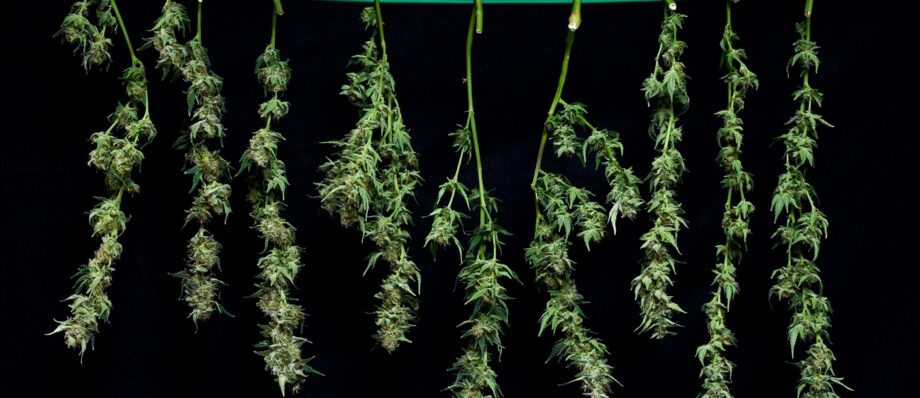
In that room, hanging on lines strung between two nails, is the harvest of five plants, because five plants is what the draft law says an adult may grow, and this grower, a careful person, a law-reading person, grew exactly five.
No more.
Not a stalk over the line.
There is a kitchen scale on the table.
A kettle is coming to the boil in the next room.
And as the buds come down off the line, cured and trimmed and weighed into jars the way careful people do it, the little digital scale ticks past four hundred grams, and five hundred, and six hundred, and somewhere around seven hundred and fifty grams, without a siren, without a car, without a single soul harmed or even inconvenienced anywhere on the face of the earth, this quiet person standing in a spare room with a cup of tea going cold becomes, under the number the state is drafting, a criminal facing up to five years in prison.
No brick left anyone’s hand.
Nothing was sold.
Nothing was trafficked.
Nobody ran.
There was no officer to assault and no median to die in.
There was only a permitted plant, grown to its permitted number, doing the one thing a plant does, which is grow, and a line drawn through the middle of an ordinary lawful season by people who have never harvested anything in their lives.
When the Law Creates Criminals
That is not law enforcement.
That is the manufacture of criminals where there are none.
New York needed a quarter tonne and a car chase to make its felony.
South Africa is drafting a felony that needs neither.
It will mint them in silence, out of spare rooms, out of back gardens, out of the honest work of people who did exactly what they were told they were allowed to do.
The Number Is a Mood, Not a Fact
On 2 February 2026 the Department of Justice published its draft regulations under the Cannabis for Private Purposes Act, and there, in the flat grey prose of a man who fears abundance, was the number.
Seven hundred and fifty grams.
That is the ceiling a South African adult may possess in a private place before the state decides you belong in the machine.
Five plants, no more, at any time.
Break the ceiling and the penalty runs up to five years inside.
If you imagine seven hundred and fifty is some solid, scientific, carefully reasoned figure, consider that the parent Act itself has wandered between six hundred grams for a person living alone and a full one point two kilograms for a household, and that the draft then produced seven hundred and fifty as if from behind your ear.
The number is not a measurement of harm.
There is no harm to measure.
The number is a mood.
It moves with whoever is holding the pen, and it will land, wherever it lands, on people who have hurt no one.
The Arithmetic They Will Not Do
Here is the sentence the drafters could not bring themselves to write, because to write it is to confess the swindle.
They grant you five plants and they criminalise what five plants produce.
Walk it slowly, the way they never will.
A single healthy female plant, grown outdoors in honest South African sun, will dry down to anywhere from a couple of hundred grams to a kilogram or more, depending on season, genetics, and the grower’s patience.
One plant.
The state, in its generosity, licenses you five.
Five plants is not a stash, it is a small annual harvest, a green wall of summer, and when you cut and hang and cure the thing the law expressly permitted you to grow, you will be standing in that spare room holding two, three, four kilograms of a substance you produced entirely lawfully, and at the moment it finishes drying you become, on paper, a felon.
The permit and the prison are printed on the same page.
The seed is legal, the soil is legal, the water and the labour and the whole aching optimism of a season are legal, and the result is a crime.
Nature never agreed to the gram.
The plant does not consult the schedule before it decides how heavy to grow.
It will come up in a crack in the pavement if you let it; it has certainly never read the Government Gazette.
You cannot license a harvest and ration its weight in the same breath and call the contradiction a law.
You can only call it a trap, and then wait for careful, law-abiding people to walk into it in the ordinary course of a season.
The Man with the Clipboard
Picture him, because he is real even when he has no name.
He has never had soil under his fingernails.
He has never watched a seedling break the ground and felt the small stupid joy of it.
He fears the plant precisely because it is alive and abundant and does not answer to him, and a thing he cannot control is, to the bureaucratic soul, indistinguishable from a threat.
So he reaches for the only power he owns, which is subtraction.
He takes something living and seasonal and older than the state that presumes to ration it, and he shrinks it to a figure he can print.
Seven hundred and fifty.
Then he goes home to a life untouched by any consequence of his arithmetic, while the number he pulled from the air waits in a spare room for a grandmother growing her own arthritis relief, for a Rasta keeping faith, for a smallholder feeding a family off a plant that grows for free.
The South African Human Rights Commission saw part of this coming when it warned that cannabis users and communities, the Rastafari chief among them, have for years been left at the mercy of subjective police discretion, arrested and harassed at the whim of whoever holds the torch.
A hard number was meant to end that.
But a hard number set in the wrong place does not end the harassment.
It just tells the officer exactly where to stand with the scale, and hands him a spare room full of law-abiding felons to choose from.
Fix the Number, Not the Plant
None of this, and read it twice, is a licence to break the law as it stands.
The line is absurd, but the knee still goes in the spine, and Puff’nPost is not in the business of feeding anyone to the machine to win an argument.
Know the limits.
Respect them while they exist.
The median strip in Saratoga County is what the wrong side of a weight law looks like from the grass, and no essay is worth that view.
But know this too: the number is a draft, not a commandment, and a draft can still be argued with.
The fight has moved from the comment pile to the finalisation of these regulations and to the overarching Cannabis Bill still promised to Parliament.
That is where the ceiling is set in stone or set right.
The demand is neither complicated nor radical.
It is only that the people who write a harvest law should first learn what a harvest weighs; that five plants and their honest yield should live inside the same rule instead of contradicting each other; and that the punishment for growing a permitted plant too well should not be a cell.
New York kept the scale and called it progress, and the scale went out across the fields at speed with the troopers behind it.
South Africa is quietly drafting a scale that needs no chase at all, that will produce its criminals in silence from ordinary lawful seasons, and that is the more dangerous machine, because a country notices a car chase and does not notice a spare room.
We still have a narrow moment to write a law that knows the difference between a dealer and a season, between a quarter tonne of freight and a jar of one family’s autumn.
We should take it before the number hardens, before the men with the clipboards win by default, the way they always do when nobody makes them do the math.
Stop manufacturing criminals where there are none.
Puff’nPost is the storytelling voice of CannaStaySA, an information and directory platform. We do not sell, supply, or facilitate the supply of cannabis, and nothing here encourages anyone to exceed the limits of the law as it currently stands. This is opinion and policy commentary, not legal advice.
CannaStaySA is an information and directory platform; we don’t sell or supply cannabis, and nothing here is legal advice. The law in this area is still moving, so check the current position before you rely on it. What we can do is point you toward lawful, welcoming, cannabis-friendly places to stay and things to do — the legal part of the experience, done properly.