Pablo’s Revenge
- August 26, 2026
- Cultivation & Genetics
- 10 mins read
Notes on the genealogy of a good night, and the long dirty road a Michigan cross took to get to a Karoo stoep.
By JBS | CannaStaySA | Puff 'n Post
A man of God handed it to me in the Klein Karoo. He did not make a ceremony of it. He had the jar in his hand the way another man has a pen, and he opened it, and the room changed temperature.
I have been given a great deal of cannabis in my life by people who wanted me to be impressed. This was not that. He was not selling anything and he was not proving anything, and that is the only condition under which anyone has ever handed me something genuinely good.
It was the best I have ever smoked. I want to be careful with that sentence, because it is the sort of sentence men say about the last thing that happened to them, and it usually means the company was good and the sun was going down. But I have had time to reconsider it and I am not reconsidering it. It was the best I have ever smoked.
What follows is my attempt to find out why, which turned out to be a longer road than I expected, and which ends somewhere I did not intend to go.
The name is doing a job
It is called Pablo’s Revenge. It was bred by a man who works under the name Tiki Madman, out of Michigan, who planted his first seed at thirteen and has spent the last decade with his hands in other people’s genetics, which is not an insult, it is the whole trade.
Now, the name. Pablo’s Revenge. You are meant to hear cartels and speedboats and a certain kind of danger you can buy in a jar, and there is a whole industry built on that transaction, the selling of a small legal thrill to a man who has never been in any danger at all. The cannabis business learned this from the liquor business, which learned it from the tobacco business, which learned it from whoever first worked out that a product is only a product but a story can be sold twice.
Forget the name. The name is the label on the bottle. What is in the bottle is a family, and the family is where it gets interesting.
The family
On paper it is simple. Animal Mints crossed with Sherb Cake. Two American cultivars, both out of the Seed Junky stable, which feeds the modern cannabis market the way Grey College feeds the Springboks. Check the team sheet. They are always on it.
And the joke runs deeper than the team sheet, because Grey College is named for Sir George Grey, Governor of the Cape from 1854 to 1861, who pledged two thousand pounds towards a seminary in Bloemfontein in the October of 1855, approved an Act to found a second school carrying his name in Port Elizabeth the following June, and saw both of them open their doors in 1859. He left the Cape in 1861. The first recorded game of anything resembling rugby was played in this country at Green Point in August 1862, between the officers of the army and the gentlemen of the civil service, and it finished nil all.
So the man never saw a South African rugby match in his life and he has been supplying the Springboks for a hundred and sixty five years. Two endowments, one Victorian signature, and the game still walking around in his blazer at both ends of the country, in the Free State and in the Bay.
Hold that thought.
Go one generation back and it opens up. Animal Mints is Animal Cookies crossed with SinMint Cookies. Animal Cookies is Girl Scout Cookies crossed with Fire OG. SinMint Cookies is the Forum cut of Girl Scout Cookies crossed with Blue Power.
Come down the other side. Sherb Cake is Sunset Sherbert crossed with Wedding Cake. Sunset Sherbert is Girl Scout Cookies crossed with Pink Panties. And Wedding Cake, which is the piece that matters, is Triangle Kush crossed with Animal Mints.
Read that last one again.
The thing hiding in the pedigree
Animal Mints is on both sides of this cross. It is standing in the open as one parent, and it is sitting inside Wedding Cake, inside Sherb Cake, on the other side. It appears twice in its own grandchild.
And Girl Scout Cookies is on nearly every branch. Three times if you count carelessly. Four if you follow it properly.
That is Sir George Grey. One founder, endowed early, present on every team sheet since, and nobody stops to notice because by now the name has become the furniture.
So here is what Pablo’s Revenge actually is, stripped of the speedboats. It is not an exotic wide cross between distant strangers. It is a concentration. It is a breeder taking a family he already knew intimately and folding it back into itself, which is not a thing you do casually, because it is how you fix a trait and it is also how you fix a fault.
That is the real story and nobody markets it, because concentration does not photograph. Cousins marrying is not a sales pitch. But it is what produced the plant, and it explains everything about the plant, and I would rather know it than not.
What the folding gives you is certainty. Every Cookies trait that was scattered across four grandparents gets stacked and reinforced until there is nowhere else for the plant to go. The density is not an accident. The frost load is not an accident. The colour is not an accident, and neither is the fact that the flavour runs entirely to dessert and diesel with nothing green or wild left anywhere in it. Whatever wildness the Cookies line ever had was bred out three generations before anybody thought of a name like Pablo.
What the folding takes away is vigour, and the plant’s willingness to survive circumstances its breeder never imagined.
Which brings us to the Karoo
Because that is the part I could not stop thinking about.
A bud built like this, packed to that density, loaded with that much resin, with the internal structure of a fist rather than a flower, is a botrytis magnet. It is a rot waiting for an invitation. Run it through a humid Natal summer, or anywhere along the subtropical belt where the air holds water, and it will go grey and dusty in the middle while the outside is still posing for the camera. You will cut it open on the drying line and find that the best-looking plant you ever grew died from the inside out a week before you noticed.
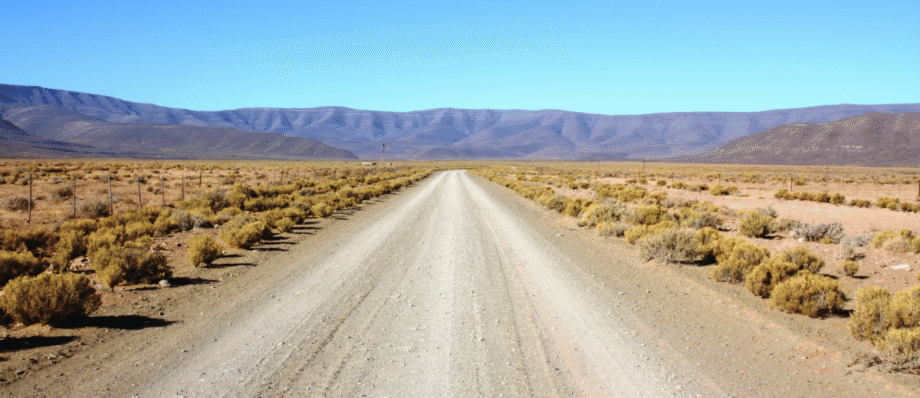
Now put it in the Klein Karoo.
Heat all day and no water in the air to speak of. Nothing for the rot to work with. And then the thing the interior does that no coastal grower can buy and no indoor grower can quite reproduce, which is the temperature falling off a cliff at sundown, that great diurnal swing, forty degrees at three in the afternoon and a jersey by eight, night after night through the back end of flower. Cold nights are what pull the colour out of a Cookies line. That purpling everybody photographs and pretends is a potency signal is anthocyanin, and anthocyanin is a stress response, and stress is the one thing the Karoo hands out for free.
So every weakness bred into that plant by three generations of folding stopped mattering, and every strength got expressed to its limit, in a landscape where nothing else grows without an argument.
I did not smoke something exceptional by luck. I smoked a cultivar that had finally arrived, after a long and undignified journey, at the one climate on earth that had been waiting for it. And nobody planned that. A man of God in the Klein Karoo put a plant in the ground, and the ground turned out to be the point.
There is a lesson in there for a country that keeps trying to sell its coastline.
The numbers are a story too
They will tell you it runs 26 to 32 percent THC, with the plus sign after it that always means somebody is hoping.
That figure is a marketing number attached to a genotype, not a laboratory result attached to your plant, and the difference between those two things is the difference between a wedding photograph and a marriage. Massachusetts pulled flower off its own shelves this year and tested it, in a regulated market with real penalties, and found roughly one in five samples were not compliant with the potency printed on the label. That is what the number is worth where the number is policed. Consider what it is worth here, where it is not.
It was strong. I do not need a percentage to tell me that and neither do you. But the percentage was never the reason it was good. Potency is the least interesting thing a plant can offer you and it is the only thing anybody bothers to print.
A warning about the name on the jar
There is more than one Pablo’s Revenge moving around the world. There is the clone, the actual cut, a single plant copied forward, which is the thing the Americans queue for. And there are seed lines, an F2, and a cross with something called Devil Driver, and seeds are not the cut. Seeds are the cut’s children, and children are a lottery.
So when somebody in this country tells you he has Pablo’s Revenge, the only question worth asking is whether it descends from the cut or from a packet, because those are different plants wearing the same surname and only one of them is the plant I am describing.
How did it get here
This is where I stop enjoying myself.
A cup-winning cross bred in Michigan, propagated and sold in California by nurseries that test every mother for viroid and publish the result, turned up in a jar in the Klein Karoo and made its way down to the Bay, and not one link in that chain can be documented by anybody.
No provenance. No authentication. No test. Nobody can tell you whether the mother it came off was clean, and hop latent viroid does not announce itself, it simply removes a third of your yield and a chunk of your cannabinoids while the plant stands there looking healthy enough to photograph.
That is not a criticism of the man who grew it. He did nothing wrong and he grew it beautifully, and the only reason I can write any of this is that he was generous with something he had no obligation to share. It is a criticism of a country that has had eight years since the Constitutional Court and has still not built one institution capable of writing down what we have.
Because that is what is actually out there. The best genetics in the world are already in this country. They are in sheds and tunnels and back gardens from the Cape to the Lowveld, held by people who are on no register anywhere, propagated off mothers nobody has ever tested, moving hand to hand on trust and reputation and nothing else at all. It is an enormous undocumented national asset and it is decaying quietly while we wait for a Bill.
Somebody is going to write it down eventually. Whoever does will own the only thing in this industry that cannot be imported, undercut, or bought out from under them.
The stoep
But that is a business problem and it can wait until Monday.
What I have is the memory of a jar opening in a dry room, and a plant that travelled four generations of American money and one ocean to end up somewhere nobody intended, and did the best work of its life there, in the dust, in front of a man who was not trying to sell me anything.
Everything good I have ever been handed came from someone who was not selling. I do not know what to do with that except write it down.